


On 17 June, the European Civic Forum hosted its annual policy debate, in cooperation with the National Federation of Polish NGOs (OFOP), and the Stefan Batory Foundation. The conference, which took place in Warsaw, was titled “Strengthening democracy and the Rule of Law in Europe in the face of polycrises: Polish EU civil presidency”, and also received funding support from the Mercator Stiftung. The event also took place in partnership with the Net4Defenders project, co-funded by the European Union. The project supports activists and civil society actors in monitoring civic space restrictions and promoting democratic resilience across member states.
The policy debate built on momentum from 2024, following the Civil Society Forum in Warsaw and taking over the mantle of the first Civil EU Presidency, which saw Hungarian civil society shadow its country’s official EU Presidency. Drawing together around 80 participants, including civil society leaders from Poland, the wider EU, and the Western Balkans, as well as EU and Polish policymakers and philanthropic donors, the conference served as a launchpad to influence the EU policy agenda over the next five years in areas such as the defence of democracy, the rule of law, and the EU civil society strategy and how these are supported through the Multiannual Financial Framework (MFF).
In their opening remarks, ECF Co-President Raffaella Bolini and Stefan Batory Foundation Director Ewa Kulik-Bielińska reflected on the crucial role of civil society in the midst of overlapping global crises: Russia’s war against Ukraine, the escalating violence in Gaza and across the Middle East, the ongoing climate emergency, and rising economic and social precarity. They underscored the need to safeguard civic space as a cornerstone of democracy, fundamental rights, and equality.
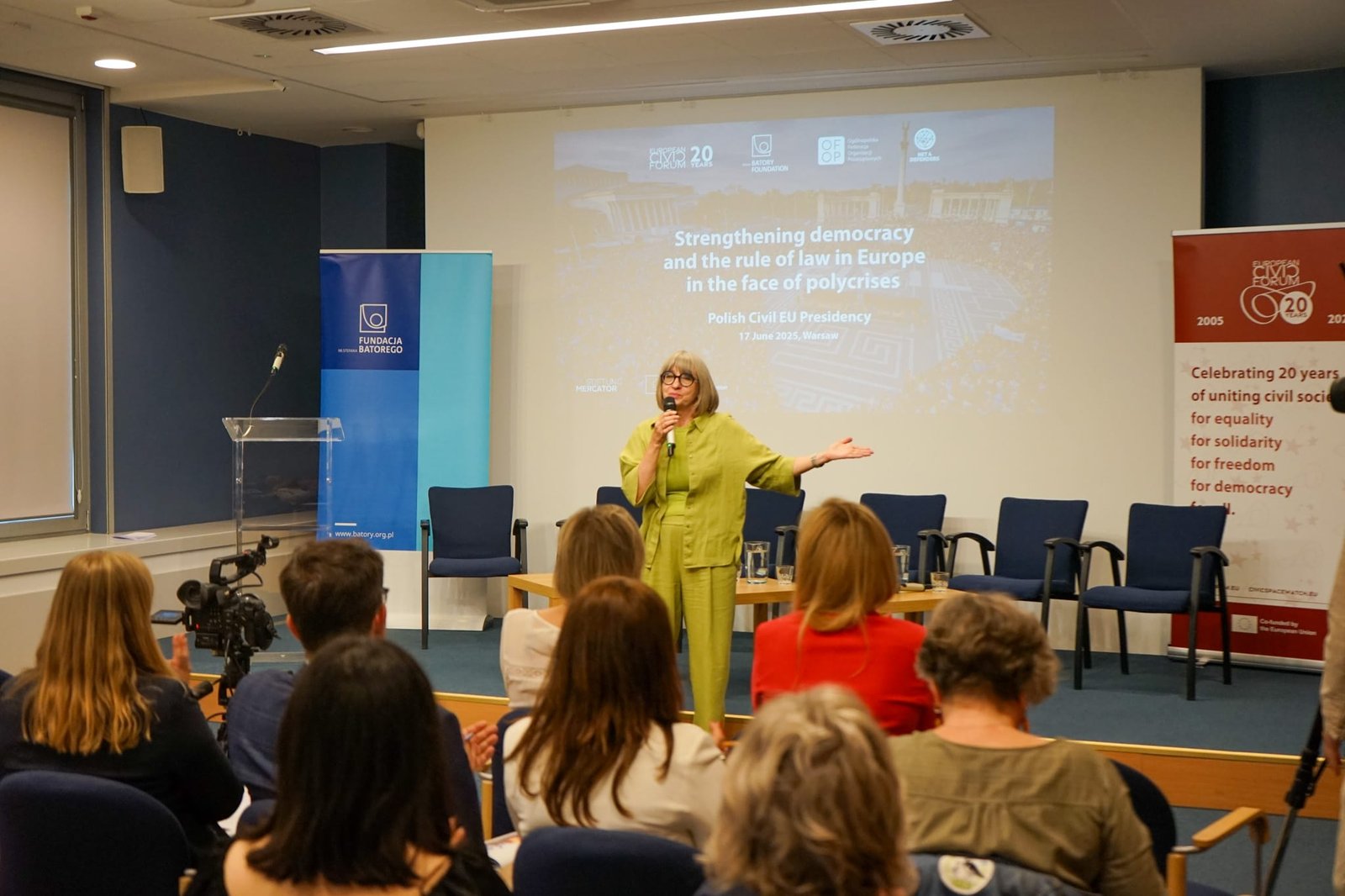
In her keynote speech, Adriana Porowska, Polish Minister for Civil Society and Chair of the Public Benefit Committee, highlighted the growing pressure on NGOs and made a strong case for stable funding, robust infrastructure, and long-term capacity building so civil society can effectively respond to crises.
The event also featured two dynamic panel discussions. In this first, focusing on civil society’s priorities for strengthening democracy, civic space, and the rule of law in Europe, the conference heard from Ignacy Niemczycki, Secretary of State in the Chancellery of the Prime Minister of Poland, Ingrid Bellander-Todino, Head of Unit for Fundamental Rights at the European Commission’s Directorate-General for Justice and Consumers, as well as ECF Secretary General Alexandrina Najmowicz, OFOP Director Karolina Dreszer-Smalec and the Stefan Batory Foundation’s Filip Pazderski. They delved into challenges facing civil society, including shrinking civic space, delegitimisation of organisations, and funding cuts. They also called for deeper trust-building between EU institutions and grassroots organisations and advocated for greater investment in the upcoming Multiannual Financial Framework (MFF) and the Civil Society Strategy.
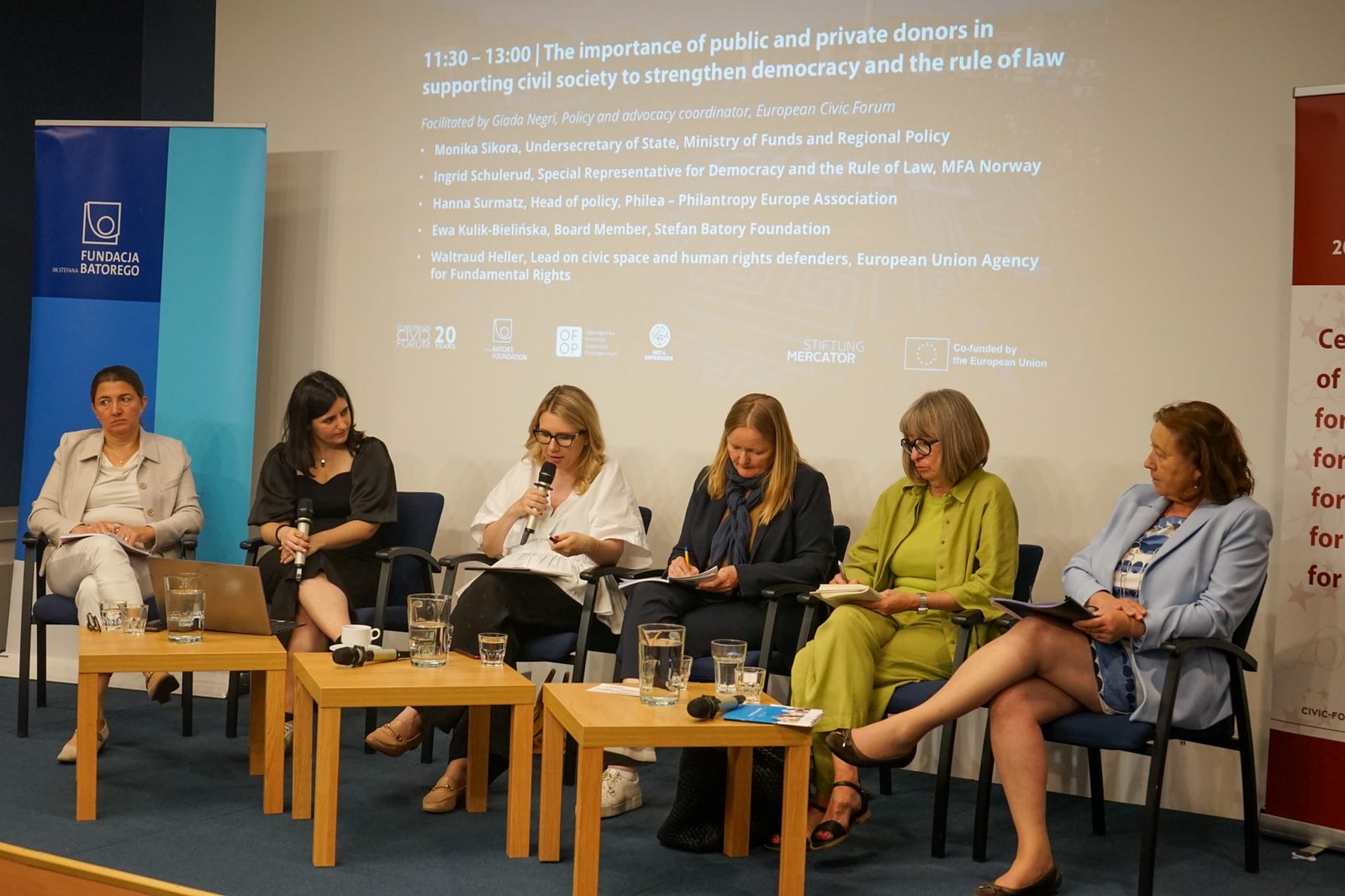
The second panel focused on the importance of public and private donors in supporting civil society. It featured contributions from Monika Sikora, Polish Undersecretary of State, Ingrid Schulerud, Special Representative for Democracy and the Rule of Law, at the Norwegian foreign ministry, Hanna Surmatz from Philea – Philanthropy Europe Association, Ewa Kulik-Bielińska, and Waltraud Heller, Lead on civic space and human rights defenders at the Fundamental Rights Agency (FRA).
Drawing on a recent FRA survey revealing that 89% of protection-related support (like legal aid, digital security, and psychological support) is currently self-funded by CSOs, panellists urged a paradigm shift in funding narratives. There was strong consensus on the need to prioritise purpose-driven funding and enhance cross-border philanthropy. Discussions also included calls to model future EU funding frameworks on initiatives like the Norway/EEA Grants, which earmark 10% of their budgets for civil society.
As the conference drew to a close, the baton was passed symbolically to civil society representatives from Denmark and Ireland — countries set to assume the upcoming EU presidencies. These actors reaffirmed their commitment to placing democracy, rule of law, and civil society funding at the top of the European agenda.
Didn’t catch the event live? Watch the full recording here